Research
Our applied research focuses on how to deliver agents safely, efficiently, and with improved real-world performance — critical for any AI application, but work that sits outside of any agent's core product logic.
Model Routing
Great agent UX starts with using the best model for a task — fast and cheap when it can be, smarter when it needs to be — and our routing research gives developers the controls to do exactly that. Our policy-based router captures your evals and preferences, while our performance-based router learns from real traffic over time, so you can evolve model choices without retraining.
Governance & Learning
Building an agent is easy — knowing what it does in production and how to improve it is very hard. Our research focuses on making agent behavior observable and governable: studying how agents respond to real and adversarial traffic, policy changes, and turning signals into learning loops that make agents safer and more effective over time.
Agentic Performance
Better system performance comes from directing traffic to the right agents for each task or workflow. We build compact orchestration models that manage traffic between agents — ensuring clean handoffs, preserved context, and reliable multi-agent collaboration across distributed systems.

Meet Plano-Orchestrator. Our latest models.
Plano-Orchestrator is a family of state-of-the-art routing and orchestration models that decides which agent(s) or LLM(s) should handle each request, and in what sequence. Built for multi-agent orchestration systems, Plano-Orchestrator excels at analyzing user intent and conversation context to make precise routing and orchestration decisions.
Accurately route with confidence with no compromise
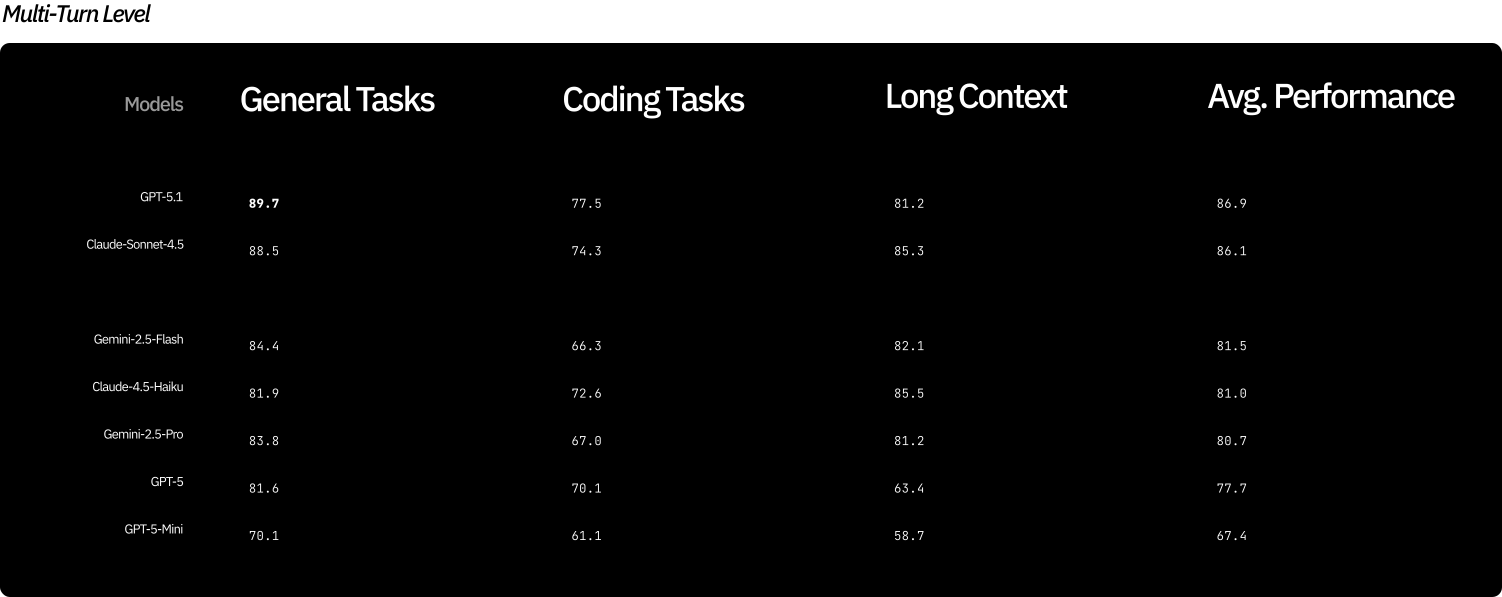
Designed for real-world deployments, it delivers strong performance across general conversations, coding tasks, and long-context multi-turn conversations, while remaining efficient enough for low-latency production environments.
Multi-turn Understanding
Makes routing decisions based on full conversation history, maintaining contextual awareness across extended dialogues with evolving user needs.
Multi-Intent Detection
Identifies when a single user message requires multiple agents simultaneously, enabling parallel/sequential routing to fulfill complex requests
Content-Dependency Routing
Correctly interprets ambiguous or referential messages by leveraging prior conversation context for accurate routing decisions.
Conversational-Flow Handling
Understands diverse interaction patterns including follow-ups, clarifications, confirmations, and corrections within ongoing conversations.
Multi-turn Understanding
Makes routing decisions based on full conversation history, maintaining contextual awareness across extended dialogues with evolving user needs.
Multi-Intent Detection
Identifies when a single user message requires multiple agents simultaneously, enabling parallel/sequential routing to fulfill complex requests
Content-Dependency Routing
Correctly interprets ambiguous or referential messages by leveraging prior conversation context for accurate routing decisions.
Conversational-Flow Handling
Understands diverse interaction patterns including follow-ups, clarifications, confirmations, and corrections within ongoing conversations.
Production excellence, outperforming frontier LLMs